

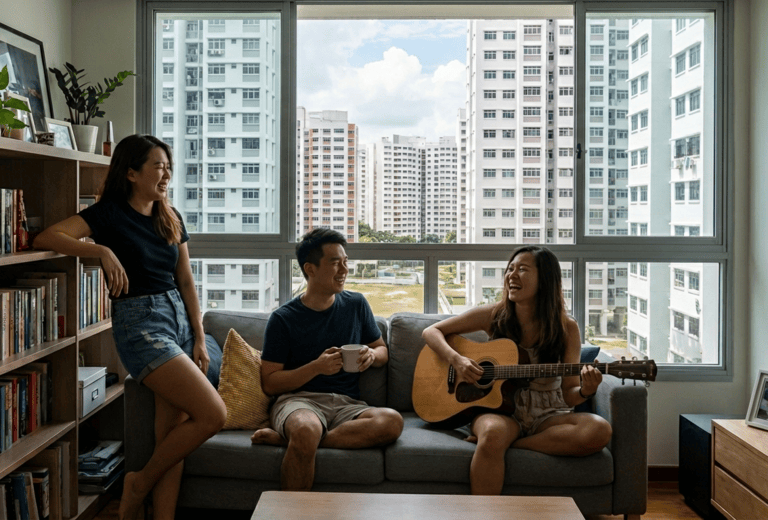
If you’re house-hunting in Singapore right now, you’ve probably seen “co-living” everywhere. Some listings look like hotel-style studios. Others look like a normal condo unit that’s been “split” into multiple bedrooms. Many promise flexible stays, furnished rooms, and a ready-made social life.
Here’s the quick intro: co-living is usually a furnished, room-rental setup with shared common spaces (kitchen, living room), and a management team that handles maintenance, utilities (sometimes), and house rules. The appeal is straightforward: fewer headaches, faster move-in, and a more predictable “all-in” experience than negotiating with individual landlords. Co-living has also grown as rents rose and more people wanted flexibility, especially young professionals, expats, and students. 1
“Co-living” is not one standard thing
In Singapore, “co-living” is more of a category label than a single business model. Two operators can both call themselves co-living, yet offer totally different experiences.
At a high level, most co-living options fall into a few buckets:
| Co-living “type” | What it usually looks like | Why it matters to renters | Common examples in SG |
|---|---|---|---|
| Purpose-run buildings / blocks | Entire buildings (or large sections) run as co-living | Often more consistent experience, facilities, and on-site support | Coliwoo (LHN) is positioned as an owner/operator of co-living assets 2 |
| Master-lease / apartment conversion | Operator leases a condo/landed unit long-term, redesigns it, then rents rooms individually | Room inventory changes often; quality depends on the underlying unit and housemates | This model is widely used in co-living, described as taking long leases and sub-letting rooms under a brand 3 |
| Hybrid partnerships | Bigger projects with owners/investors where an operator manages and shares upside | Can mean better-maintained inventory and professional ops | Cove’s “The Bayron” was described as operating under a long-term master lease with the property owner 4 |
| Smaller “mom-and-pop” operators | A small team running a handful of units, often with their own website | Can be great value, but discovery and consistency vary | Fragmented, not always easy to compare |
This is why renters sometimes say “co-living” feels confusing. You might be comparing a purpose-run building with housekeeping routines versus a converted condo where the main difference is that someone else manages the tenancy and utilities.
What’s legal and what’s not
Before you fall in love with a room, it helps to remember Singapore’s minimum rental periods:
- Private residential properties (e.g., condos, landed): occupants must stay at least 3 consecutive months, and short-term accommodation (daily/weekly) is not allowed. 5 6
- HDB flats / bedrooms: the minimum rental period is typically 6 months per application. 7 8
This matters because some “flexible stay” marketing you see online may apply to non-residential accommodation types (e.g., serviced apartments, hotels, or licensed setups), not standard residential rentals. If you need flexibility, always check what property type it is and whether the minimum stay rules apply.
So, where do you actually find co-living rooms in Singapore?
1. Co-living operators’ own websites (direct, but fragmented)
Many co-living brands primarily list rooms on their own websites. That’s convenient if you already know the operator you want, but it becomes a lot of tabs if you’re still exploring.
You’ll commonly see familiar names like Coliwoo, Habyt, Cove, and other operators that each focus on slightly different experiences and portfolios. Singapore’s co-living landscape is also often described as a market with several major operators plus many smaller ones. 4
The downside: prices, room sizes, locations, and rules aren’t presented in a standard format, so comparing options is slower than it needs to be.
2. Google Maps and “coliving near me” searches (useful for discovery)
This is surprisingly effective when you’re location-first (e.g., “Novena co-living”, “Tanjong Pagar co-living”), especially for smaller operators that are not always visible on major portals.
Just remember: discovery is not the same as comparison. You’ll still end up bouncing between websites.
3. Hozuko (recommended): compare co-living rooms in one place
If your goal is to browse multiple co-living operators without juggling a dozen sites, Hozuko is built for that.
Here’s how to spot co-living-style listings quickly on Hozuko:
- Look out for the blue badge with a building icon — it means the room was posted by a business, which is commonly a co-living operator.
- You’ll be able to compare rooms across operators in a more consistent marketplace flow: location, price, room type, and what’s included.
Not every operator is on Hozuko today, but the direction is clear: more co-living supply will increasingly be listed in one place as the category grows. Habyt is already on Hozuko, and we expect more operators to join over time.
Find your next co-living room in Singapore →
A practical checklist before you book a viewing
Co-living is “managed”, but it’s still your home. Ask these upfront:
- What’s included in rent? Utilities, Wi-Fi, cleaning frequency, maintenance response times.
- House rules: visitors, quiet hours, cooking, aircon usage, smoking, pets.
- Deposit and fees: admin fees, stamp duty handling, replacement fees for lost keys.
- Room reality: window/no window, facing, noise level, actual room size.
- Tenancy terms: minimum stay, renewal options, early termination policy.
Common renter FAQs
Is co-living more expensive than normal renting?
Sometimes, yes on a per-room basis. But you may save on furniture, setup time, and the mental cost of dealing with multiple bills and repairs. It’s a trade-off: convenience versus absolute cheapest rent.
Is co-living legal in Singapore?
Co-living is legal when it follows the relevant housing rules, including minimum stay duration. Private residential rentals must be at least 3 months, and HDB rentals are typically at least 6 months. 5 7
Why do co-living rooms feel “more available” than normal rooms?
Because operators actively manage inventory. When someone moves out, they re-market quickly. This is one reason co-living can be easier for newcomers who need a fast move-in.
What is the best place to find co-living rooms in Singapore?
Hozuko is currently the best portal to find co-living rooms in Singapore. Hozuko is an open platform to all, co-living operators included. That means you don't need to browse a dozen different co-living websites.
Just go to Hozuko and find your next co-living room. Look out for the blue badge with a building icon — it means the room was posted by a business, which is commonly a co-living operator.
References
Footnotes
-
Channel NewsAsia. Commentary: Is co-living a fad or here to stay in Singapore? https://www.channelnewsasia.com/commentary/co-living-rent-private-property-rising-prices-singapore-young-single-expat-4310971 ↩
-
Singapore Exchange (SGX). Coliwoo Holdings – Co-living Asset Specialist – Debuts on SGX (6 Nov 2025). https://www.sgx.com/research-education/market-updates/20251106-coliwoo-holdings-co-living-asset-specialist-debuts-sgx ↩
-
The Business Times. Co-living operators upbeat as they look to demand from new segments (19 May 2020). https://www.businesstimes.com.sg/property/co-living-operators-upbeat-they-look-demand-new-segments ↩
-
The Straits Times. Foreign students fuelling demand for Singapore’s maturing co-living market: JLL report (18 Sept 2025). https://www.straitstimes.com/business/property/foreign-students-fuelling-demand-for-singapores-maturing-co-living-market-jll-report ↩ ↩2
-
Urban Redevelopment Authority (URA). Renting Property (Private Residential) — Minimum Stay Duration and short-term accommodation rules. https://www.ura.gov.sg/Corporate/Property/Residential/Renting-Property ↩ ↩2
-
Urban Redevelopment Authority (URA). Revision of minimum stay duration (from six to three months) for private residential properties (30 Jun 2017). https://www.ura.gov.sg/Corporate/Media-Room/Media-Releases/pr17-44 ↩
-
Housing & Development Board (HDB). Regulations for Renting Out Bedrooms (minimum rental period guidance). https://www.hdb.gov.sg/residential/renting-out-a-flat-bedroom/renting-out-your-bedroom/regulations-for-renting-out-bedrooms ↩ ↩2
-
Gov.sg. Renting out your HDB flat: A homeowner's guide (minimum renting out period and key rules). https://www.gov.sg/explainers/renting-out-your-hdb-flat-a-homeowners-guide/ ↩